
Team Members


Mobile HCI
Motivation and Aim
The world we in live today is filled with vast amounts of information. This information is what enables us to complete fundamental tasks in our lives whether it is for studying purposes, gaining an edge over competitors in business or simply wanting that basic cooking recipe. With the realization that information plays a vital role in today’s society, there becomes a need to gain access to this information in a quick and easy manner. One such way of distributing information that has become very popular in recent times is through the use of “peer-to-peer” file sharing systems. In recent time’s popular desktop file sharing systems such as Napster, Kazaa and Gnutella have allowed people from all over the world to share information. These systems have been confined to the desktop but imagine the power they could bring, if they could be imported onto a mobile platform.
The aim of this section of the project is to develop an interface for a file sharing system that will exploit the unique tiling interface of the Windows Phone platform. In addition to this, the project will pay close attention to design principles and develop a sense of co-presence for users using the system. The interface will allow users to specifically choose whom they wish to send files to (Synchronous Transfer) as well as be able to send files to a number of people (Asynchronous Transfer). In addition to this users will be able to see nearby users as well as choose the files they wish to send.
Design
The diagram below depicts the two main functions of the file sharing system: Being able to select specific users and choosing files to be transferred.
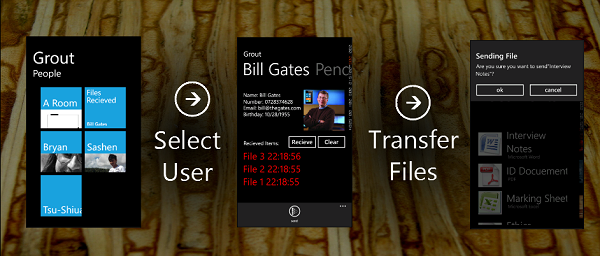
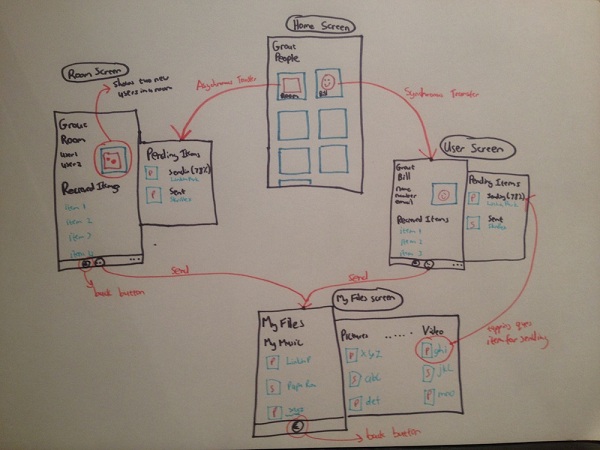
The design methodology followed throughout the course of the project is user-centered design. The user-centered design process was chosen because it allowed the researcher to ensure that focus was placed on understanding the users’ needs. The user-centered design process adopted by the researcher included users having a deep impact on the design by involving them as partners with the researcher throughout the design process. A variety of methods were used to support the user-centered design process that include the use of participatory design and design guides. Prototypes were developed at each iterative cycle and evaluations were conducted at each stage to assess the effectiveness of the designs. The following diagram is an interface sketch of the early stages of design which was taken from the participatory design sessions.
Final System Demo
The following displays a demo walkthrough of the final system.
Results
A number of evaluations were conducted for the low and high fidelity prototypes with students from the University of Cape Town in order to come up with the final system. From the evaluations of the high fidelity prototype, there were a number of changes that needed to be implemented to the system. Minor changes were made to all the screens to enhance their user friendliness and make them easier to navigate. The final system was evaluated once more, the results from the evaluations indicated that users were able to navigate around the application and perform pre-defined tasks in an effective manner.